
Diogenes Syndrome and Decluttering in Switzerland
Behind extremely cluttered homes often lies suffering, isolation, and a profound difficulty asking for help. Discover how to better understand Diogenes Syndrome in Switzerland and what solutions can make it easier to take the first step toward decluttering.
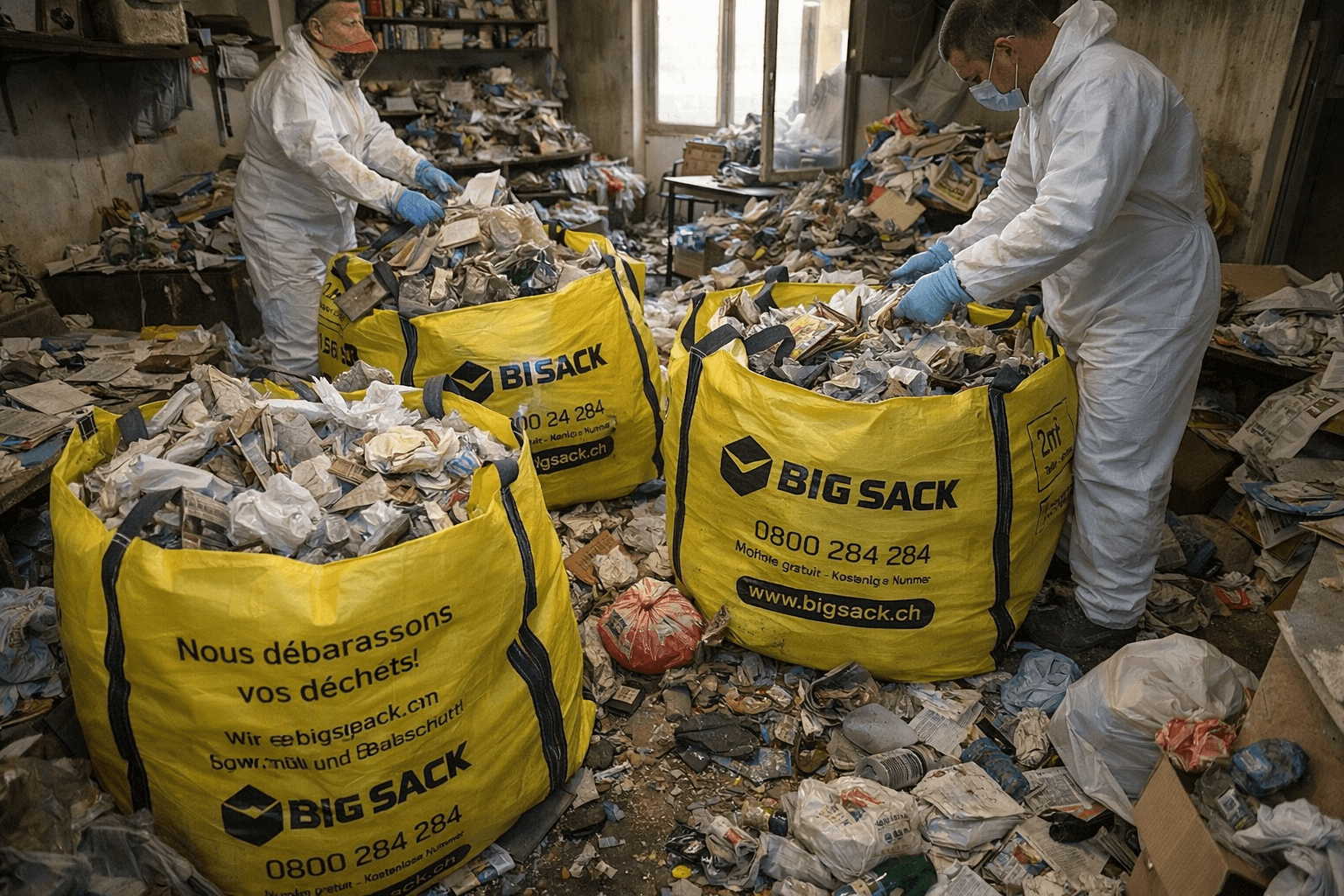
Diogenes Syndrome and Decluttering in Switzerland: Understanding to Better Support
We still talk too little about Diogenes Syndrome in Switzerland. Yet this reality exists everywhere: in cities as well as in the countryside, among elderly people as well as younger adults, in precarious as well as affluent environments. The subject remains taboo, often hidden behind shame, isolation and fear of judgment. This is precisely what was recently shown in the Temps Présent documentary, "Diogènes, une montagne de souffrance", broadcast by RTS on February 12, 2026, which depicted a "hidden" reality that is difficult to quantify.
At Big Sack, we have encountered this type of situation several times in the field. Behind some extremely cluttered homes, there is not simply a waste or decluttering problem: there is profound suffering, an accumulation that has become unmanageable, and often an immense difficulty in taking the first step. In this context, simple, progressive and non-intimidating solutions can make a real difference.
Diogenes Syndrome is not just "keeping too many things"
The term "Diogenes Syndrome" is often used to describe situations of extreme accumulation, neglect of hygiene and withdrawal from the world. But specialists remind us that it is not always an autonomous psychiatric diagnosis. According to experts quoted in French-speaking Switzerland, it is more a description of observed symptoms than a single disease in itself, often associated with other conditions such as dementia, psychosis, anxiety disorders, mood disorders, or with trauma and social isolation.
In other words, these situations should not be reduced to laziness, carelessness or a simple lack of organization. In many cases, the person concerned does not seek help on their own, either because they no longer fully perceive the extent of the problem, or because discarding objects causes them immense stress. Professionals also stress that a brutal intervention rarely works and that progress must be made with respect, patience and empathy.
A reality more widespread than one might think
The RTS documentary emphasized a key point: this reality largely escapes statistics in Switzerland, which contributes to its invisibility.
To our knowledge, there is no official national Swiss figure to precisely estimate the number of people affected. However, several sources converge on the fact that the phenomenon is far from marginal. The magazine In Vivo, drawing on Swiss specialists from the CHUV, indicates that Diogenes Syndrome affects 1 to 2 people per 10,000 in industrialized countries, while noting that prevalence increases with age and that all social classes can be affected.
It is also important to distinguish Diogenes Syndrome from hoarding disorder. On this point, international scientific literature provides a useful benchmark: a meta-analysis published and referenced on PubMed estimates the prevalence of hoarding disorder at 2.5% of the adult population, with an estimated range of 1.7% to 3.6%.
These figures do not mean that 2.5% of Swiss people suffer from Diogenes Syndrome in the strict sense. However, they show that when it comes to hoarding disorders, we are talking about a phenomenon far more common than generally believed. And when it becomes visible, it is often already at an advanced stage.
Why taking action is so difficult
In this type of situation, the difficulty is not only logistical. It is also deeply psychological.
Clearing out a very cluttered house or apartment can seem insurmountable. For the person concerned, every object may seem important, irreplaceable, or simply too difficult to let go of. The idea of a large-scale clearance "all at once" — with a skip, a large team or a very visible intervention — can become paralyzing. This is where a gentler approach can help.
How Big Sack can help concretely
At Big Sack, we have observed that simply having large, sturdy, visible yet easy-to-use bags can reduce the psychological barrier to decluttering. Instead of imagining a massive and brutal operation, the person (or their loved ones) can begin step by step.
One bag to fill, then a second. One room, then one corner of a room. A first sort-through, without necessarily turning everything upside down at once. This progressive logic changes a great deal:
- it makes the action more concrete and less intimidating;
- it allows progress at one's own pace;
- it sometimes avoids having to immediately organize a large-scale operation;
- it provides a sense of visible progress, which can be very important psychologically.
In the most complex cases, Big Sack is obviously not intended to replace medical, social or psychological support. However, it is often a practical decluttering solution that can facilitate the first step — whether for the person concerned, their loved ones, a legal guardian, a helpful neighbor, or a professional intervening in the home.
The right approach: support, but do not rush
Field recommendations all point in the same direction: pure coercion or authoritarian clearance can worsen distress. The City of Geneva notes that in serious situations, it is often necessary to involve professionals — a family doctor, social worker, specialized services — and to proceed with care.
In practice, this means that a successful clearance is not just about removing objects. It is about recreating safer, healthier and more bearable living conditions, without overwhelming the person with the violence of sudden change.
A societal issue we must face squarely
The merit of the Temps Présent documentary is precisely that it brought this subject back into the public sphere. It reminds us that behind saturated homes, odors, waste and unsanitary conditions, there are above all complex human stories, made of loneliness, suffering and sometimes very long silence.
Better understanding Diogenes Syndrome therefore also means better understanding why concrete, simple and non-stigmatizing solutions matter so much. At Big Sack, we firmly believe that helping to declutter is not just about removing waste: it is also about helping to make a first step possible.