
From collection to recycling: the journey of your waste
Ever wondered where your waste goes after pickup? Discover the three main destinations in Switzerland: recycling centers, incineration facilities, and landfills.
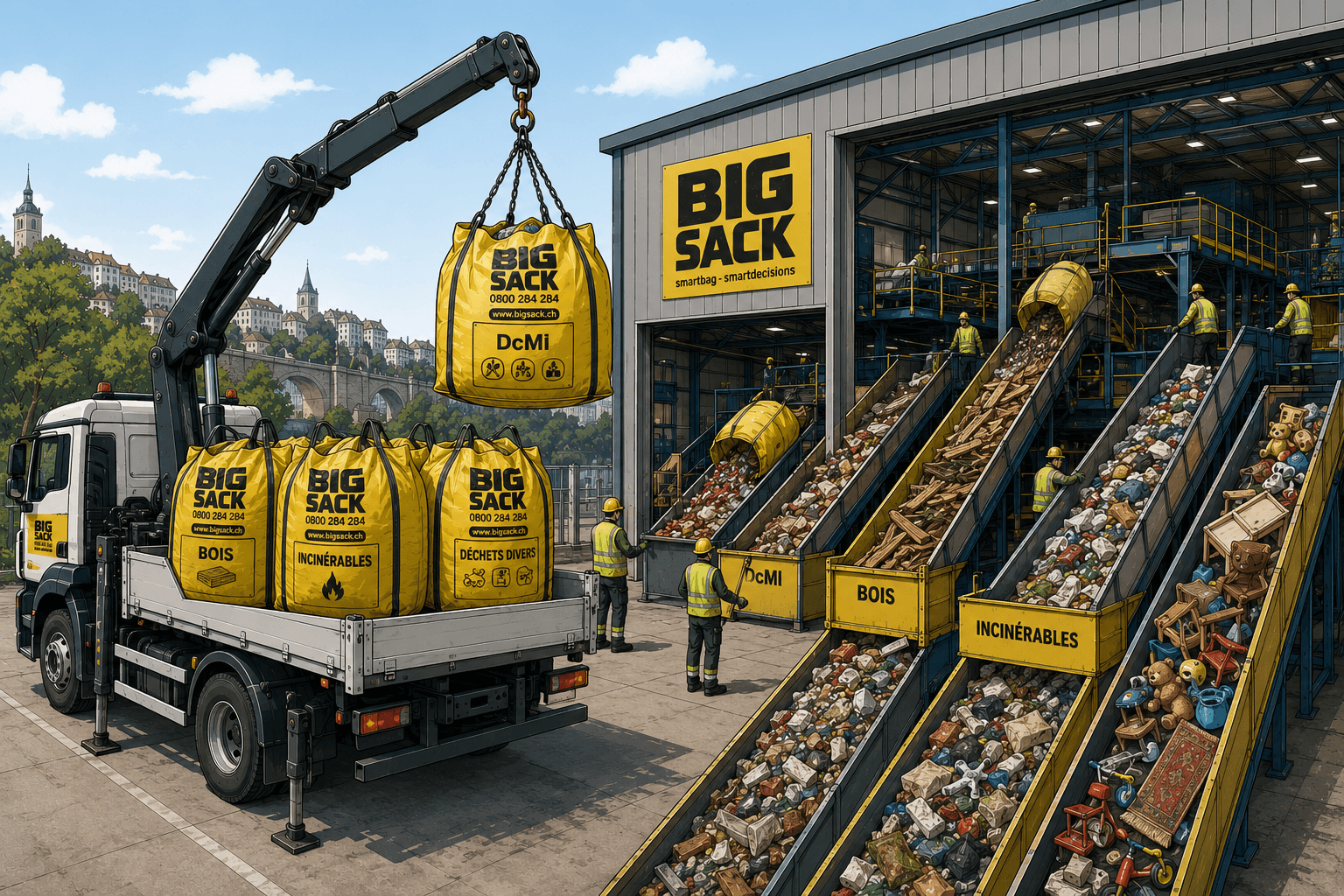
Recycling collection points are numerous in Switzerland and can be found on recycling-map.ch. Selective and rigorous collection is essential for waste valorization. Let us explore the three main destinations for your waste: recycling centers, incineration facilities, and landfills.
Recycling Centers
Common recyclable materials include aluminum, glass, PET, paper, and cardboard, as well as construction waste such as clean wood, metals, organic waste, plaster, and insulation materials.
Specific organizations manage each material stream:
- IGORA cooperative: aluminum recycling
- ATAG: glass beverage containers
- Pet-Recycling Schweiz: PET bottles
- SENS eRecycling Foundation: electrical and electronic waste
Metals are recycled in foundries and steel mills. Organic waste undergoes composting or fermentation for reintegration into the soil. Specialty materials like plaster have limited recycling centers.
Incineration Centers
All household waste, bulky waste, and treated wood are incinerated. These UIOM facilities are heavily regulated and produce minimal harmful emissions. The energy generated is converted into district heating or electricity and supplied to the public grid.
Landfills
Switzerland maintains five classified landfill types:
- Type A: excavation materials (unpolluted soil and stone)
- Type B: inert materials (tiles, bricks, stones, roof tiles, rubble, window glass, porcelain)
- Types C, D, E: specialized categories (very few exist in Switzerland)
Key Issues and Solutions
The main problems are that too much recyclable waste ends up being incinerated and too much inert waste goes to Type B landfills instead of being sorted and recycled. Early-stage sorting and transport optimization are critical improvements.
Big Sack contributes to solving these issues. Our flexible Big Bags enable on-site sorting, reduce truck transport by half compared to traditional solutions with dumpsters, and optimize routes through recycling partnerships.